Algeria Sahara Photography Guide: Djanet, Tadrart and the Stone Forest
By Alex Wides, landscape and panoramic photographer · Updated · 11 min read

The best landscape photography in Algeria is in the far south, around Djanet near the Libyan border: rock castles rising from golden dunes in the Tadrart and the Tassili region, with the Stone Forest and Elephant Rock among the iconic spots. Go in March for mild temperatures and the start of the Milky Way season, fly into Djanet, travel by 4x4 with an experienced Tuareg team, sleep in tents on the sand, and plan to shoot all night.
Key takeaways
- Southern Algeria, around Djanet, is the part for landscape photographers: sandstone castles on golden dunes, canyons, caves and dry riverbeds.
- Djanet airport is surrounded by dunes: the desert starts the moment you land.
- March is our favourite month: mild days, cold but manageable nights, and both the Milky Way arch and the vertical Milky Way.
- You travel by 4x4, three photographers per car, with a Tuareg team of drivers, cooks and musicians, and sleep in tents on thick mattresses.
- Entry paperwork and photo gear at the airport need experience: on our tours the agency handles the visa and the group travels together.
- Pack a tripod, a star tracker, a remote and a red headlamp, and dress in layers: days in a T-shirt, nights close to 0 °C when it is windy.
Where to photograph in Algeria
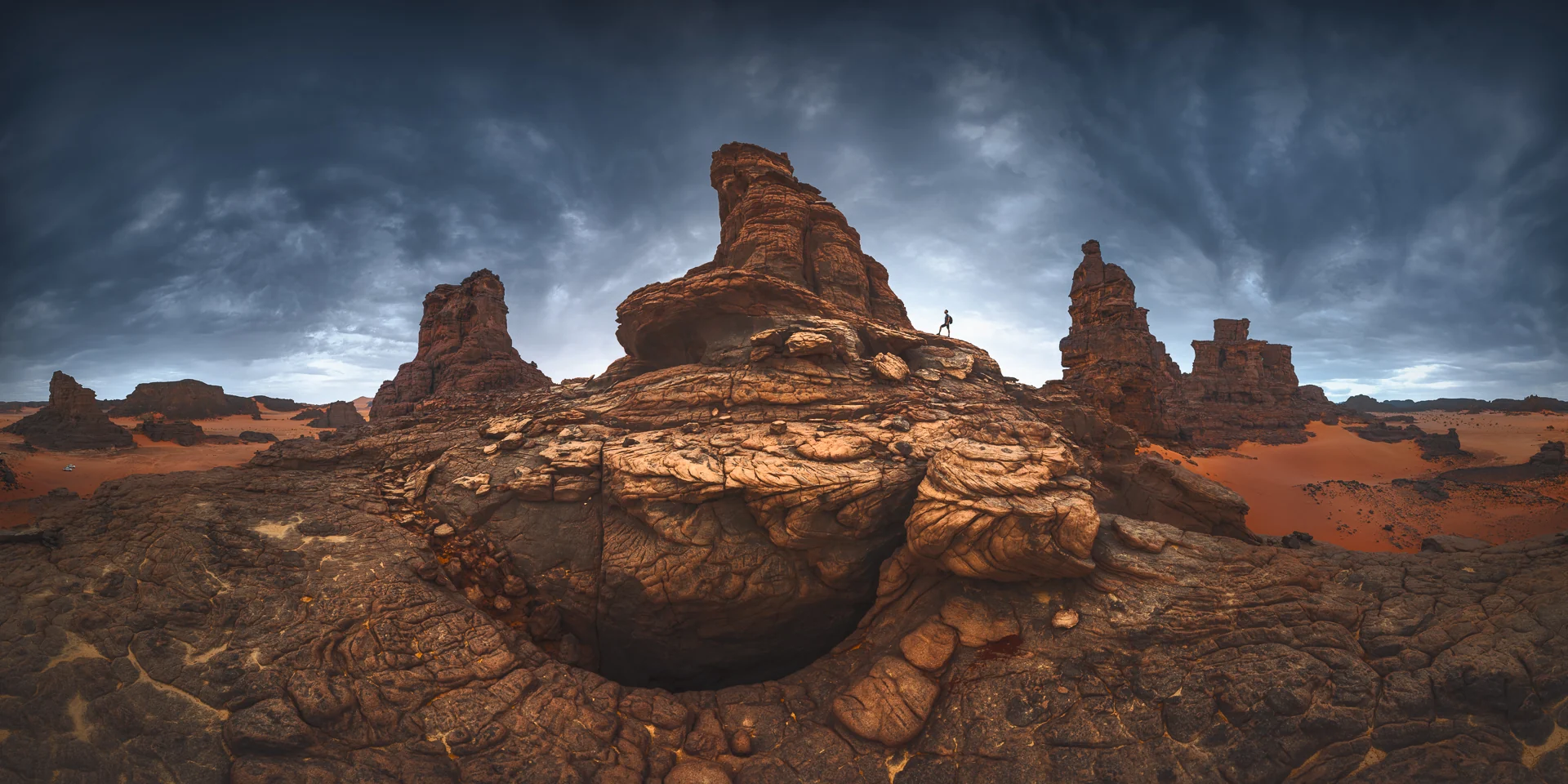
Algeria is huge, and for a landscape photographer the two halves are very different. The part worth the trip is the far south, near the border with Libya, around the oasis town of Djanet: the Tadrart and the Tassili region. Here sandstone castles rise straight out of golden dunes, dry riverbeds carve canyons between giant monoliths, and caves and hollows open everywhere in the rock.
I discovered these places when Daniel Kordan proposed a scouting trip. With Giorgia, my partner, who runs the travel agency I work with, we spent a long time researching the territory, the areas and above all the local guides, until we found a very experienced Tuareg team.


Getting to Djanet
You fly into Djanet, normally with a connection in Algiers. Landing in Djanet is a surprise in itself: the airport is surrounded by dunes, so the desert starts the moment you step off the plane. I have never seen anything like it anywhere else.
From there everything moves by 4x4: three photographers per car with their bags, one car just for luggage and one for the kitchen. The logistics of the Tuareg team are impressive. In the desert we have had a puncture, got stuck in the sand, even had a car break down: they changed the tyre, dug us out and swapped the car, every time without fuss. It is part of the adventure.
Visa, customs and safety
Entry is the part that worries people most. Checks at the airport can take a long time, and officers who see a lot of camera gear sometimes assume you are a journalist. Over the years we have learned how to prepare: which visa to apply for, which documents to carry and how to present the photo equipment.
Southern Algeria has a reputation in Europe that, in my experience, does not match the reality of travelling there with an organised local team. Still, always read your own government’s travel advice before you book, and travel with people who know the area.
Best time to go
March is, for us, the best month. The weather is mild, you avoid the colder and wetter winter months, and since you sleep in tents a temperate climate makes a real difference.
March is also the start of the Milky Way season, which in the desert runs roughly from March to September. It is one of the best moments of the year, because in a single night you can photograph the Milky Way arch and, at other hours, the vertical Milky Way. Moonlit nights are worth planning too: the moon brings out shadows and highlights on the dunes that you do not get any other way. And do not rush back to camp after sunset: the blue hour here is a moment of its own.

Key locations
- Stone Forest: probably the most iconic place in the region, a forest of wind-carved rock pillars where you can work dozens of compositions, both panoramas and single frames. We always spend the night there.
- Elephant Rock: a famous rock arch shaped like an elephant. I photographed it from inside a hollow in the rock, to frame it like a cave and give it all its strength.
- El Berdj Canyon and Erg Admer: sandstone canyons and dune fields, good from sunrise on.
- Moula Naga, Tilalin and Tikobawin: rock towers, natural arches and neolithic rock art, for sunsets and nights.
- Caves everywhere: the rock is full of caves and hollows, so you can build a natural frame almost anywhere.


A day and a night in the desert
We drive between locations, stop for lunch in the shade while the Tuareg set up a table, then go on exploring. The light is good for much of the day, and the skies are often dramatic: storms, rain and even rainbows, which are more frequent lately according to Mohamed, our lead guide. Heavy clouds over the sand give strong blue and orange contrasts.
In the evening we photograph the sunset while the team sets up camp: tents, table, kitchen. Dinner is rich, and then comes the best part of the trip: the fire. The Tuareg are wonderful musicians, with drums, guitars and percussion, and they play, sing and dance around the fire, often until the moon rises. They let you play too. It is one of those moments that make you realise how happy people can be with very little, and it relaxes everyone before the night session.
Night photography in the Sahara
After the fire the night is yours. Whoever needs help stays with the tour leaders, especially for the Milky Way with a star tracker, which is a little more complex. Whoever is independent can wander off into the formations: getting back to camp is easy, but save the camp position in Google Maps, which works well offline, or on your watch.
There is no time limit. You shoot the Milky Way, as an arch and vertical, star trails, and the moonlit landscape, which is simply breathtaking with wind-polished dunes and black, dramatic rocks. Then you either push through to sunrise or sleep a few hours and come back for it. The schedule is free, and the desert at night is an intimate, almost spiritual experience.

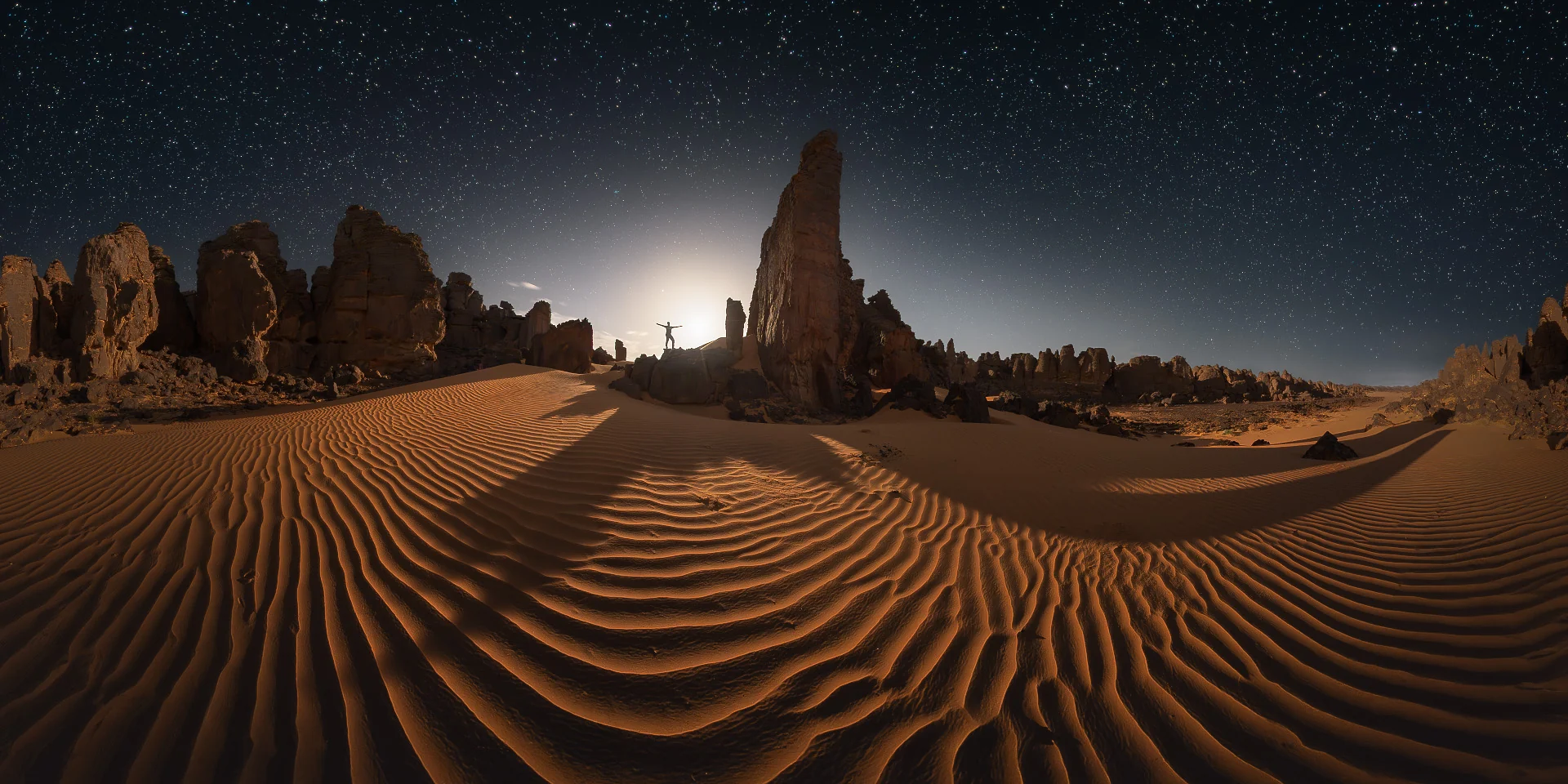
Star trails are the other classic of these nights. In the Stone Forest I shot a full 360° star trail panorama (you can see it in the key locations above): if you want to learn the method, it is all in my 360° Star Trail Panoramas course.
Foregrounds and technique
The foregrounds here are extraordinary, and photographers love them in panoramas and single frames alike. To keep everything sharp from the rock at your feet to the horizon, you will often use focus stacking and focus bracketing. On the tour we explain these techniques step by step, together with panoramas from inside caves, where the cave walls become the frame of the landscape.
What to pack
- Camera and lenses, and plenty of enthusiasm: the possibilities are practically endless.
- Tripod: essential, you shoot a lot at night.
- Star tracker for the Milky Way.
- Remote shutter release.
- Headlamp with a red light.
- Layers: T-shirt and shorts during the day, neck gaiter, gloves and a hat at night. On a windy night the temperature can get close to 0 °C.
Tents and thick folding mattresses are provided: sleeping on the sand is far more comfortable than it sounds.
The story behind “Last Fireworks”
The idea came while Daniel and I were exploring a canyon during the lunch stop. We decided to stay there for the sunset, off the plan: the Tuareg had chosen another place for the night. We talked with them, they showed us photos, and we realised we wanted to stay. That flexibility is part of how these trips work.
We climbed a steep, rocky hill. Daniel wanted to stop halfway, I wanted to go higher. At the top I could not find a composition, so I started down the easier side. Then Daniel called me from above. I went back up from the other side and saw what he had found: huge amphitheatres of red rock, castles of sandstone lighting up at sunset, dry riverbeds carving canyons between giant monoliths. It was the last evening of our scouting trip, and the sky gave us an extraordinary sunset.
“Last Fireworks” was later named Open Photographer of the Year at the 2025 Epson International Pano Awards. The sunset helped, but what made the picture was the place itself, and above all the foreground.
Photograph it with me
I lead a small-group photo expedition to the Algerian Sahara with Isabella Tabacchi, from 13 to 20 March 2027: 8 days around Djanet with a Tuareg team, full-board camps, night sessions and coaching in the field. The agency handles the visa, and we travel together from the same meeting point.
See the Algeria Sahara photo tour: itinerary, price and booking
Frequently asked questions
Where is the best landscape photography in Algeria?
In the far south, around Djanet near the Libyan border. The Tadrart and the Tassili region have sandstone castles rising from golden dunes, canyons, caves and the Stone Forest, the most iconic location of the area.
How do you get to the Algerian Sahara for photography?
Fly to Djanet, usually connecting through Algiers. From Djanet the trip continues by 4x4 with a local Tuareg team that handles driving, camps and food.
What is the best month to photograph the Algerian Sahara?
March. Days are mild, nights are cold but manageable, it is outside the colder and wetter winter months, and it is early in the Milky Way season, so you can photograph both the Milky Way arch and the vertical Milky Way.
Do you need a visa for Algeria?
Most visitors need a visa. On my photo tours the travel agency handles the visa and the paperwork, and the group travels together from the same meeting point, which makes the entry much smoother.
Is it difficult to travel to southern Algeria?
In my experience it is much less complicated than its reputation in Europe. Entry checks can be long, and photo gear can raise questions at the airport, so experience and the right documents matter. Always read your government’s travel advice before you book.
Where do you sleep on a Sahara photo tour in Algeria?
In tents set up on the sand by the Tuareg team, on thick folding mattresses. Sleeping on sand is surprisingly comfortable.
What camera gear do I need for the Sahara?
A tripod, a star tracker for the Milky Way, a remote shutter release and a headlamp with a red light. Bring layers: T-shirt during the day, neck gaiter, gloves and a hat at night.